When the lights dimmed at Levi’s Stadium on Super Bowl Sunday, the familiar roar of the crowd turned into anticipation. Moments later, Bad Bunny emerged, not just as the halftime headliner, but as a symbol of how far Latin music — and the artist himself — has traveled.
For roughly 13 minutes, the Puerto Rican superstar transformed the Super Bowl halftime show into a sweeping celebration of culture, language, and community, blending reggaeton beats, salsa rhythms, and visual storytelling on one of the most-watched stages in the world.
The performance opened with the pulse of “Tití Me Preguntó,” instantly igniting the crowd as dancers filled the field and the stadium screens exploded with color. From there, Bad Bunny moved seamlessly through a medley of hits that spanned his career, weaving personal triumph with collective identity.
Unlike many halftime shows built around spectacle alone, Bad Bunny’s set leaned heavily into storytelling. Visuals paid tribute to Puerto Rico, and the broader Latin culture — domino tables, neighborhood scenes, and cultural symbols flashed behind him, grounding the performance in everyday life as much as global stardom.

For much of the set, Bad Bunny performed in Spanish, a choice that felt deliberate and defiant on a stage traditionally dominated by English-language pop. The crowd’s response — cheers, dancing and sing-alongs — underscored how deeply his music has crossed borders.
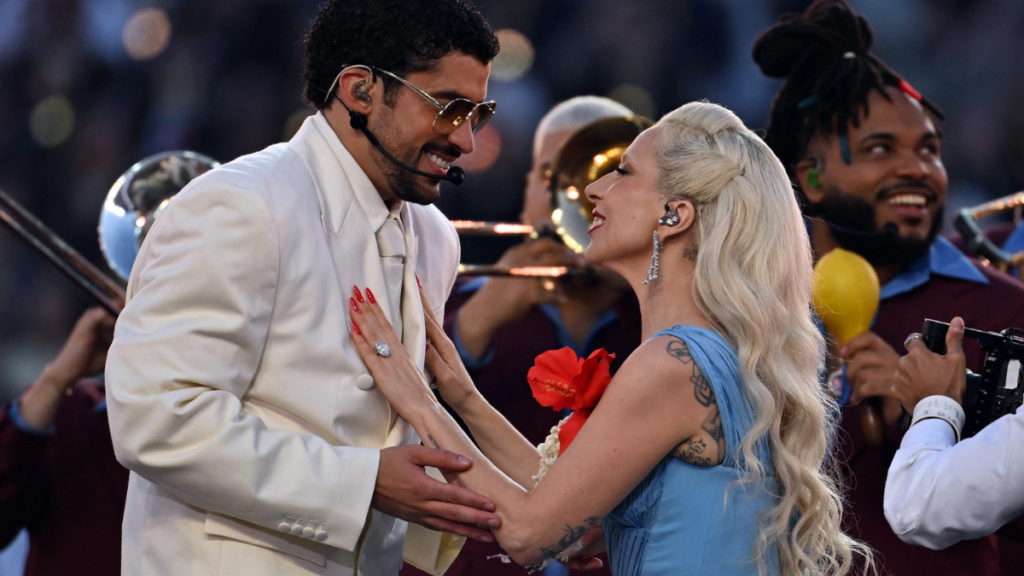
Midway through the performance, the show expanded in scope with surprise appearances that added generational weight. Ricky Martin joined the show, linking the past and present of Latin pop, while Lady Gaga’s cameo bridged genres and audiences, reinforcing the halftime show’s message of unity.
The surprises didn’t end there. Actors and musicians made brief appearances throughout the set, including moments that blurred the line between concert and performance art — most notably a real, live wedding ceremony on the field, symbolizing celebration and connection in front of millions of viewers.
As the final notes rang out, Bad Bunny stood at midfield holding a football marked with a simple message: “Together. We are America.” He spoke briefly, referencing countries across the Americas, closing the show with a call for unity that echoed far beyond the stadium.
The performance immediately sparked conversation online and across media, praised by fans for its authenticity and cultural significance while also drawing criticism from some political figures — including President Donald Trump. A reminder of how deeply representation and language remain flashpoints in American culture.
Still, for many viewers, Bad Bunny’s halftime show marked a turning point. It was not just entertainment between halves of a football game, but a statement about who gets to stand at the center of American pop culture — and in what language.
By the time the field cleared and the game resumed, one thing was certain: Bad Bunny hadn’t just performed at the Super Bowl. He reshaped what the Super Bowl halftime show could be.