




































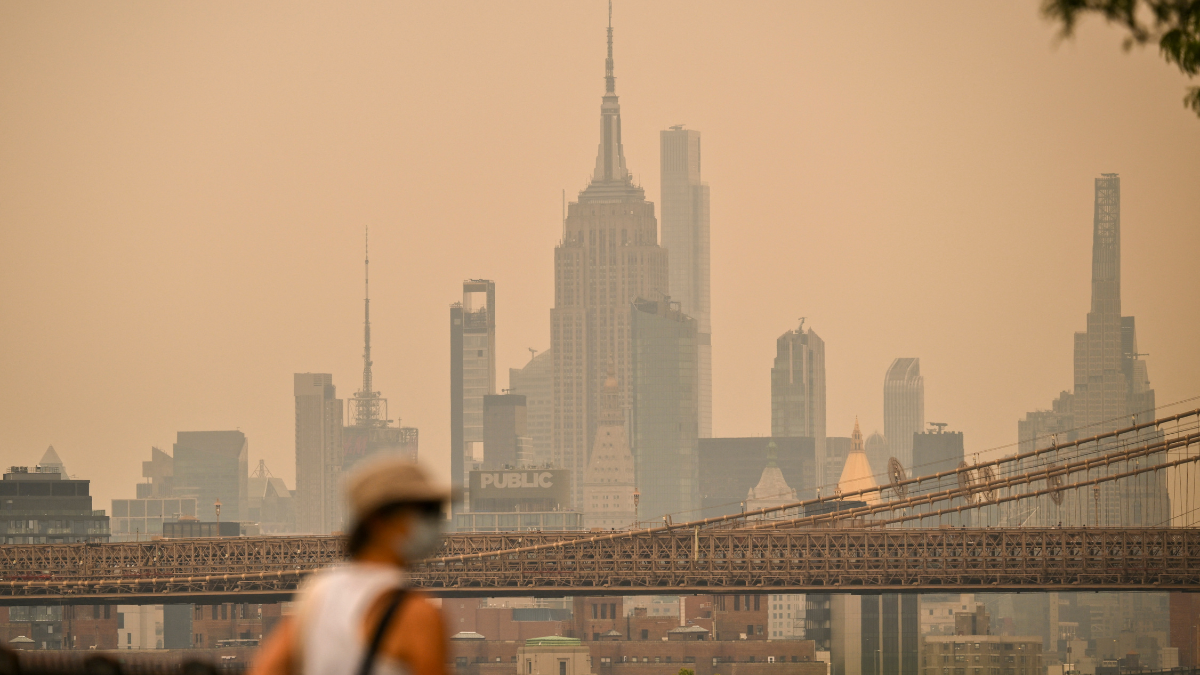
Smoke from hundreds of wildfires burning across Canada has once again blanketed much of the Northeastern United States, creating hazy skies, prompting widespread air quality alerts and raising fresh concerns about the growing reach of wildfire season beyond the American West.
From New England through the Mid-Atlantic, residents awoke to a familiar scene: skylines obscured by smoke and public health officials urging vulnerable people to stay indoors. Fine particulate pollution carried hundreds of miles from the fires pushed air quality into unhealthy ranges in several communities, affecting millions of Americans.
The smoke has become so widespread that it briefly cast uncertainty over one of the world’s largest sporting events — Sunday’s FIFA World Cup final at MetLife Stadium in New Jersey. Meteorologists now expect thunderstorms and shifting winds to improve conditions before kickoff, though a light haze and moderate air pollution could linger.
The smoke originates from an exceptionally active wildfire season across Canada, where hundreds of fires continue to burn across several provinces. Dry vegetation, persistent heat and lightning have fueled blazes that have sent enormous plumes of smoke south into the United States, affecting the Great Lakes, Midwest and Northeast.
Health experts warn that wildfire smoke poses risks well beyond irritated eyes and reduced visibility. The tiny particles known as PM2.5 can penetrate deep into the lungs and bloodstream, increasing the risk of asthma attacks, heart disease, strokes and other respiratory illnesses. Children, older adults, pregnant women and people with chronic heart or lung conditions remain the most vulnerable.
Officials across several Northeastern states have encouraged residents to limit outdoor activity when air quality deteriorates, keep windows closed, run air filtration systems when available and wear well-fitting N95 masks if prolonged time outdoors is unavoidable. Some communities have even distributed free protective masks as smoke concentrations climbed.
While weekend storms are expected to temporarily clear much of the smoke from parts of the Northeast, forecasters caution that relief may be short-lived. As long as large Canadian wildfires remain active, shifting weather patterns can send additional smoke plumes into the eastern United States with little warning.
The recurring smoke events are becoming an increasingly familiar part of summer across the Northeast, a region once largely insulated from the impacts of major wildfires. Scientists say warming temperatures and longer fire seasons are contributing to more frequent large-scale fires across North America, allowing smoke to travel thousands of miles and affect communities far from the flames themselves.