






































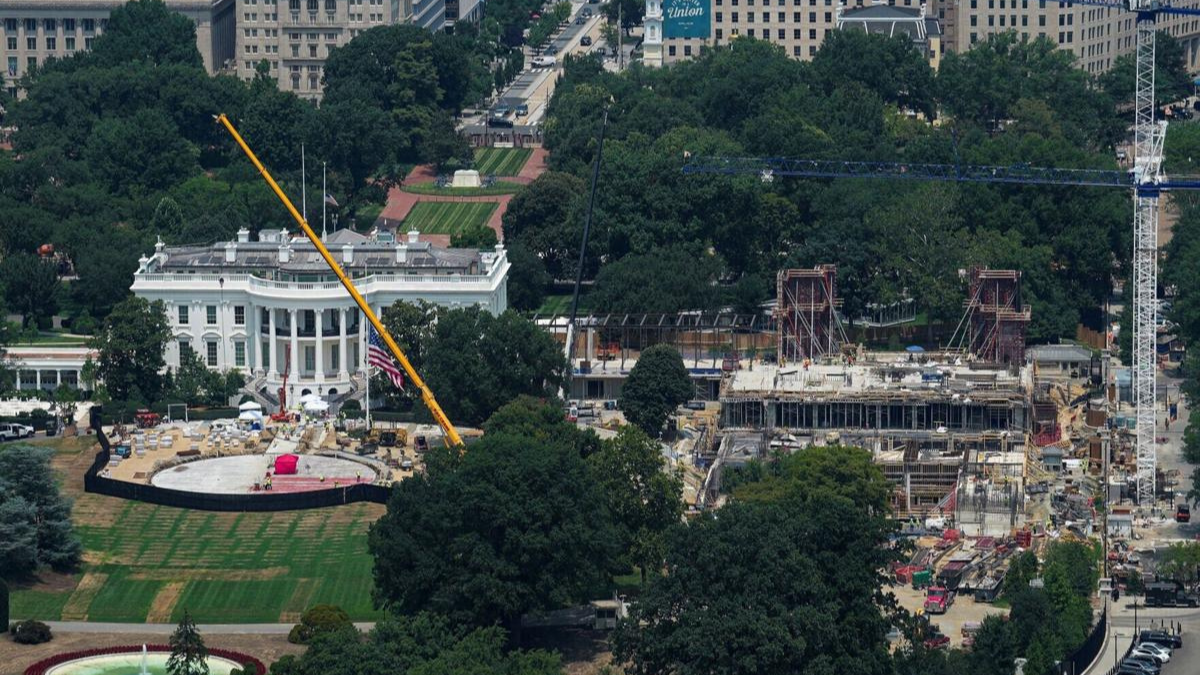
President Donald Trump’s plans for a massive new ballroom at the White House have hit a major legal roadblock after a federal appeals court ruled that his administration cannot move forward with above-ground construction without approval from Congress.
In a 2-1 decision, a three-judge panel of the U.S. Court of Appeals for the District of Columbia Circuit sided with historic preservationists challenging the project. The ruling blocks work on the roughly 90,000-square-foot ballroom planned for the site of the former East Wing.
The project, estimated to cost about $400 million, represents one of the most significant structural changes to the White House in decades. Trump ordered the East Wing demolished in 2025 to clear space for the ballroom, which he has said would accommodate nearly 1,000 guests.
The appeals court concluded that the president does not have unilateral authority to carry out a project of that scale on the White House grounds.
“Whether or not a massive ballroom should be constructed is for Congress to decide,” the majority wrote, adding that the issue was not one for “Executive self-help.”
The judges stressed that their decision was not a judgment on whether a ballroom should ultimately be built. Instead, the majority said the dispute centers on who has the legal authority to approve such a substantial alteration to the White House.
The ruling will be stayed for two weeks, giving the administration an opportunity to seek relief from the U.S. Supreme Court.
Trump vows Supreme Court appeal
Trump quickly condemned the decision, calling it “unjust” and announcing that his administration would appeal to the Supreme Court.
The president has argued that congressional authorization is unnecessary because private donations, rather than taxpayer dollars, are funding the ballroom’s construction. Trump has said corporations, wealthy donors and Trump himself have contributed hundreds of millions of dollars toward the project.
However, funding has emerged as another point of contention.
The administration previously sought $1 billion from Congress for the ballroom, a request lawmakers rejected in May. Democrats have also questioned whether hundreds of millions of dollars approved for White House security have been redirected toward parts of the project.
Trump has increasingly characterized the development as more than an entertainment venue, emphasizing security infrastructure included in the broader construction project. He said the complex would contain bomb shelters, medical facilities, military spaces and other security features.
Government attorneys have similarly argued that the work is necessary to protect the president, his family and White House personnel from threats including drones, ballistic missiles and biological hazards.
The court’s ruling does not prevent all of that work from continuing.
Underground construction involving bunkers and other national security facilities can proceed. The injunction applies specifically to above-ground construction of the ballroom.
Preservation group scores major legal victory
The National Trust for Historic Preservation filed its lawsuit against the administration in December 2025, shortly after demolition of the East Wing was completed.
The organization maintains that federal law requires congressional authorization for construction of the ballroom and has challenged the administration’s ability to make such sweeping changes to one of the country’s most historically significant properties.
The appeals court’s decision upheld an April order from U.S. District Judge Richard Leon, who had previously blocked above-ground work while allowing underground security-related construction to continue.
The appellate panel consisted of Judges Patricia Millett, Bradley Garcia and Neomi Rao. Millett, an appointee of President Barack Obama, and Garcia, an appointee of President Joe Biden, formed the majority. Rao, who was appointed by Trump, dissented.
The National Trust welcomed the decision, saying it reinforced the public’s role in decisions affecting historic landmarks.
The case has become a broader test of presidential power over the White House itself, particularly when a president seeks major structural changes without explicit authorization from lawmakers.
The ballroom has already received approval from the National Capital Planning Commission, which signed off on the final project in April. But the appeals court’s ruling makes clear that the commission’s approval does not resolve the central legal dispute over Congress’ authority.
With Trump promising an immediate appeal, the future of one of his most ambitious White House construction projects could now be decided by the Supreme Court.